Requirement
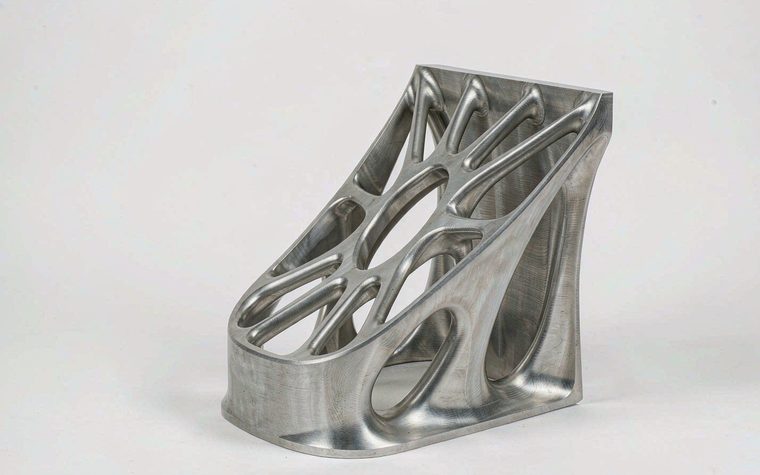
Take weight out of a structural part without losing mechanical performance, and produce it
on the equipment the customer already had. Not on a 5-axis machine they would have had to
buy to make the optimization worthwhile.
What we did
Loads, constraints, material and manufacturing requirements went in as parameters, and AI
algorithms explored the resulting design space for topology-optimized and bionic structures
that are hard to reach by hand. Each option was validated in CAE against the original
mechanical requirement before it went any further.
The optimized structure was then regenerated against actual machine capability, 3-axis and
2.5-axis, with CAM toolpaths generated from the same model, so the geometry that left the
optimization loop was the geometry that got cut. Constraining the optimization toward the
process also reduced reliance on complex fixturing compared with the original design.
Result
5.7 → 3.0
Part weight, same part before and after
3-axis
Machinable after optimization
2.5-axis
Regenerated for lower-capability equipment
Design, simulation and toolpath came off one model, so the handoff where optimization
results usually die, design tool to process engineer, didn't exist on this program.